Fine at Home, Falling Apart at School: When Challenging Behaviour Is Really Dysregulation
There is a group of children we don't talk about nearly enough.
They are the children whose parents say:
“But they're absolutely fine at home.”
At home, they might be affectionate, funny and chatty. They play with their siblings, follow reasonable requests and rarely have huge meltdowns.
Yet school describes a completely different child.
A child who refuses to work.
A child who argues with adults.
A child who shouts, swears or disrupts lessons.
A child who runs from the classroom.
A child who pushes, hits or throws things.
A child who seemingly goes from 0 to 100 over something incredibly small.
Sometimes parents can barely recognise the child being described to them.
This can quickly create tension between home and school.
School may wonder whether parents really understand the seriousness of the behaviour.
Parents may wonder what on earth is happening at school to produce behaviour they rarely see at home.
But there is another possibility we need to consider:
Both sides may be telling the truth.
The important question isn't:
“Which is the real child?”
It's:
“What is different about these two environments?”
Why can a child cope at home but not at school?
Think for a moment about what we're asking children to manage during an ordinary school day.
There is noise.
Crowds.
Transitions.
Social expectations.
Academic pressure.
Sitting still.
Waiting.
Listening.
Remembering instructions.
Sharing adult attention.
Moving quickly from one task to another.
Getting changed for PE.
Eating in a busy dining hall.
Coping with mistakes.
Working when you don't feel like working.
Ignoring distractions.
Managing friendships.
Understanding other children's intentions.
Coping when plans suddenly change.
For many children, these things are manageable.
For some, however, the cumulative load can be enormous.
A child with ADHD, autism, anxiety, sensory differences, communication difficulties, learning difficulties or other developmental needs may have to work significantly harder to manage an environment that other children navigate relatively automatically.
And eventually their capacity to cope can run out.
When the nervous system takes over
We often think of the fight-or-flight response as something that happens when we're in physical danger.
But our threat system can also activate when we feel overwhelmed, trapped, frightened, humiliated, overloaded or unable to cope.
For a child, this might happen when the classroom becomes unbearably noisy.
It might happen when they're given work they don't understand.
When they're terrified of getting something wrong.
When another child makes a comment.
When an unexpected change happens.
When they're asked to stop a preferred activity.
Or when they've successfully coped with 20 difficult things already that morning and number 21 is simply too much.
And fight-or-flight doesn't necessarily look frightened.
“Fight” can look like:
Shouting.
Arguing.
Swearing.
Throwing things.
Pushing.
Kicking furniture.
Ripping work.
Becoming controlling.
Refusing instructions.
Telling an adult to go away.
“Flight” can look like:
Running out of the classroom.
Hiding.
Wandering around school.
Constantly asking to go to the toilet.
Avoiding particular lessons.
Trying to get sent home.
Complaining of feeling ill.
And then there's “freeze”
Some children don't explode or run.
They shut down.
They put their head on the desk.
Stop talking.
Stare into space.
Refuse to start.
Appear completely uninterested.
An adult may see:
“They won't.”
But sometimes what's actually happening is:
“Right now, they can't.”
That distinction matters.
Not because expectations should disappear, but because our response needs to change.
Behaviour is information
When challenging behaviour happens repeatedly, adults naturally focus on the behaviour itself.
“He threw a chair.”
“She refused to do maths.”
“He swore at the teaching assistant.”
“She ran out again.”
Those things matter, particularly when other children or adults are being placed at risk.
But if we only document what happened at the end of the sequence, we're missing potentially valuable information.
We need to look at what happened before.
What lesson was happening?
Who was present?
What demand had just been made?
Was there a transition?
Was the classroom particularly noisy?
Had something happened at break?
Was the child hungry?
Were they tired?
Did they understand the task?
Were they frightened of getting it wrong?
Were they expected to perform or read in front of other people?
Had something unexpected changed?
Was there a conflict with another child?
Was this the fifth difficult thing they'd had to manage that morning?
This isn't about finding someone to blame.
It's about finding patterns.
Because once we can identify patterns, we can begin to intervene earlier.
Don't wait for 10/10
Imagine a child's dysregulation on a scale from 1 to 10.
At 2/10, they're okay.
At 3/10, perhaps they start fidgeting.
At 4/10, they become silly.
At 5/10, they're arguing about everything.
At 6/10, they're saying “NO” to every request.
At 7/10, they're pacing or trying to leave.
At 9/10, they're shouting, throwing things or running.
At 10/10, everyone is trying to manage a crisis.
Schools understandably become very focused on what happens at 9 and 10.
But some of the most effective support may happen at 3, 4 and 5.
The goal is to learn each child's individual warning signs.
Perhaps they become unusually quiet.
Perhaps they start making jokes.
Perhaps they repeatedly sharpen their pencil.
Perhaps they become controlling.
Perhaps every tiny request suddenly becomes an argument.
These behaviours can sometimes be the smoke alarm before the fire.
Create a regulation plan while the child is calm
We shouldn't wait until a child is in crisis to ask them what they need.
Talk when they're regulated.
Depending on their age and communication abilities, ask:
“How does your body feel when school starts becoming too much?”
“What do you notice first?”
“What makes things worse?”
“What helps?”
“How can an adult tell you're struggling?”
“Who do you feel safe going to?”
“Where could you go before things become too much?”
Together, adults and the child can develop a simple plan.
Perhaps the child has a discreet card, visual signal or agreed phrase that means:
“I'm becoming overwhelmed and I need help regulating.”
The important thing is teaching the child to use the plan before they reach crisis point.
What might regulation at school actually look like?
There isn't one universal “calming strategy”.
One child may desperately need movement.
Another needs silence.
Another wants an adult nearby.
Another cannot tolerate anyone talking to them.
Depending on the individual child and professional recommendations, helpful options might include:
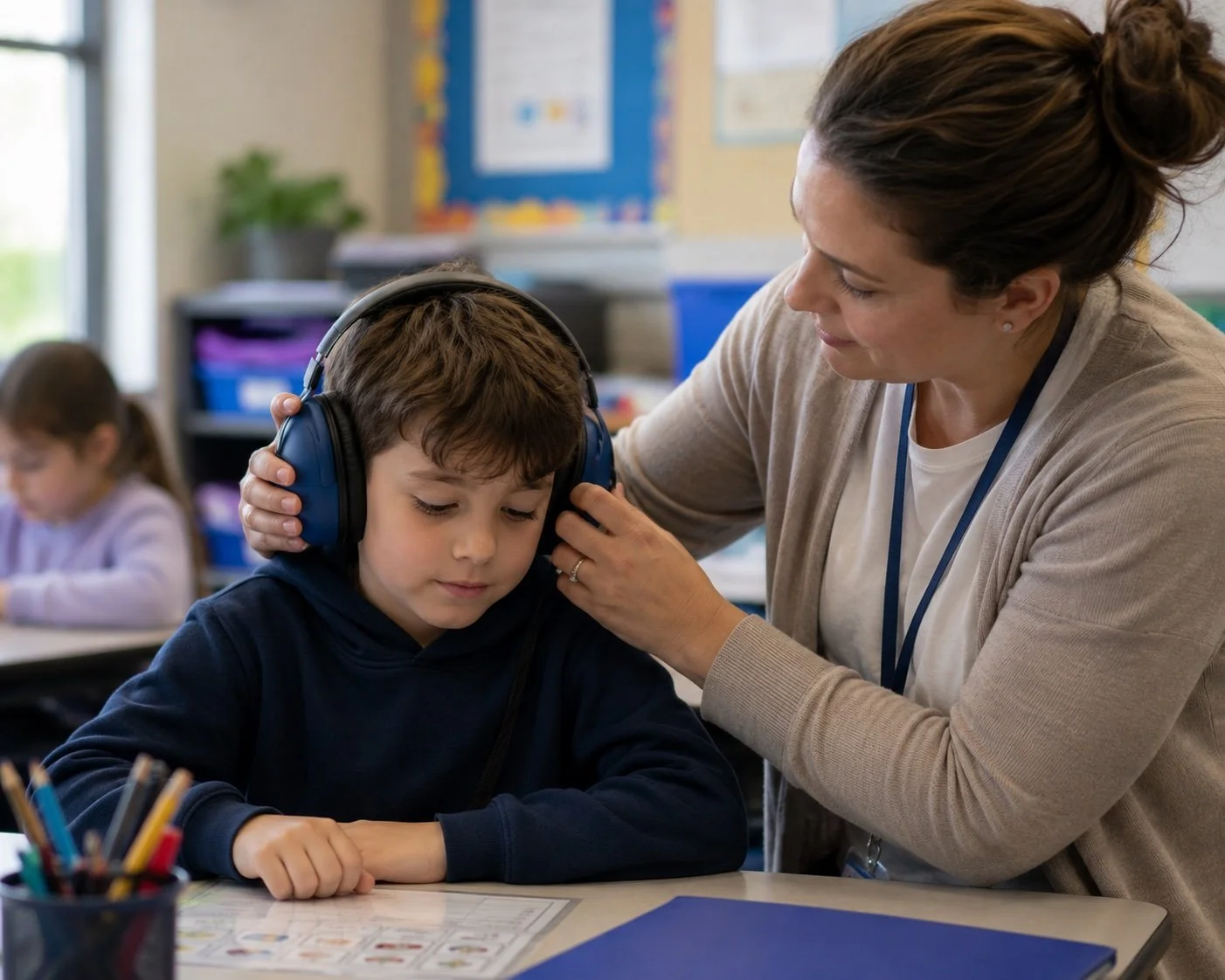
ear defenders
a quieter workspace
movement breaks
going outside
sensory activities
drawing
a drink or appropriate snack
a comfortable low-stimulation space
a weighted lap pad where appropriate
a familiar adult
reduced verbal interaction
predictable routines
visual schedules
advance warning of changes
breaking tasks into smaller chunks.
The question isn't:
“What calms children down?”
It's:
“What helps THIS child's nervous system regulate?”
Reduce language as dysregulation increases
Adults often talk more when children become dysregulated.
We explain.
Reason.
Warn.
Question.
Repeat instructions.
Discuss consequences.
Ask the child why they're behaving this way.
But the more overwhelmed the child becomes, the harder it may be for them to process all that language.
Sometimes less is more.
“I'm here.”
“You're safe.”
“Let's move somewhere quieter.”
“We'll sort the work out later.”
And where safety is involved:
“I won't let you hurt someone.”
Short.
Calm.
Predictable.
Avoid turning dysregulation into a power struggle
There will always be situations where adults have to say no.
Schools cannot remove every demand, rule or expectation.
But there is a difference between maintaining a boundary and escalating a battle.
When possible, avoid surrounding a distressed child with several adults, repeatedly issuing the same instruction, publicly confronting them or backing them into a corner where the only perceived options are submission or escalation.
Sometimes two acceptable choices can restore enough sense of control for the child to move forward.
“You can start here with me or at the table outside.”
“Would you like two minutes first, or shall we start the first question together?”
The adult still holds the boundary.
But the child has some agency within it.
Regulation doesn't mean “getting away with it”
This is incredibly important.
Understanding dysregulation does not mean that children can hurt people, destroy property or behave however they want without consequences.
Other children have a right to feel safe.
Teachers have a right to feel safe.
The dysregulated child also needs to learn boundaries.
The difference is when and how we teach them.
If a child has just experienced a massive fight-or-flight response, demanding an immediate apology and lengthy reflection may accomplish very little.
First:
Safety.
Then:
Regulation.
Then, when the child is genuinely calm:
Reflection and repair.
What happened?
What did your body feel like?
When did things start becoming difficult?
What could you try next time?
What could the adults do differently?
Did somebody get hurt?
Is there something you need to put right?
Accountability still exists.
But we're teaching it at a time when the child's brain is actually available for learning.
Every child needs a safe adult
Sometimes one of the most powerful interventions isn't a sensory tool or behaviour chart.
It's a relationship.
A child needs somebody at school who knows them well enough to notice:
“You're not yourself today.”
“You're getting overwhelmed, aren't you?”
“Come and help me with something for five minutes.”
Ideally, this relationship exists before the crisis.
Because connection can sometimes interrupt dysregulation before behaviour reaches the point where everyone is trying to contain it.
Look underneath persistent behaviour
If a child is repeatedly reaching crisis point at school, we need to become curious about why.
Challenging behaviour isn't itself a diagnosis.
It can have many possible contributors.
Professionals may need to consider things such as:
ADHD.
Autism.
Anxiety.
Sensory differences.
Speech and language difficulties.
Learning difficulties.
Dyslexia.
Social communication difficulties.
Bullying.
Sleep difficulties.
Stress or trauma.
Difficulties with particular academic demands.
Fear of failure.
Problems with friendships.
Or an environment that simply isn't currently matching the child's developmental needs.
Sometimes several things are happening simultaneously.
The behaviour is information.
We need to understand what it's telling us.
Home and school need to become detectives together
One of the least helpful things we can do is turn this into:
Parents versus school.
If a teacher says:
“We're seeing some extremely difficult behaviour.”
and a parent says:
“That's honestly not the child we see at home.”
we should believe that both experiences can be genuine.
Then get curious.
What's different at home?
Is it quieter?
Are there fewer transitions?
Does the child have more control?
Are instructions given differently?
Are sensory demands lower?
Can they move when they need to?
Do they have more individual adult attention?
Are expectations more predictable?
Equally, what works at school during the child's successful periods?
Which lessons go well?
Which adults do they respond to?
Which environments seem easier?
What happens differently on the days when everything goes right?
Don't only investigate the disasters.
Study the successes too.
They can tell us an enormous amount.
The goal isn't to remove every challenge
Children cannot grow up in environments where they're never frustrated, disappointed or asked to do something difficult.
They need opportunities to develop flexibility, frustration tolerance, communication, emotional regulation and resilience.
But we cannot effectively teach those skills while repeatedly pushing a child into crisis.
The goal is to find that space where the child is challenged without becoming completely overwhelmed.
Then gradually build their capacity.
Because ultimately we want the child to move from:
“I explode when I can't cope.”
to:
“I can notice when I'm struggling.”
Then:
“I can tell somebody.”
Then:
“I know what helps.”
And eventually:
“I can use some of those strategies independently.”
That's regulation.
It isn't permissive parenting or permissive teaching.
It isn't removing every boundary.
And it isn't allowing unsafe behaviour.
It's recognising that behind some of our most challenging behaviour is a child whose nervous system has reached the point of:
“I can't manage this anymore.”
When we understand that, the question changes.
Instead of only asking:
“How do we stop this behaviour?”
we can also ask:
“What is overwhelming this child, what skills are they missing, and what support will help them succeed here?”
That is often where meaningful change begins.